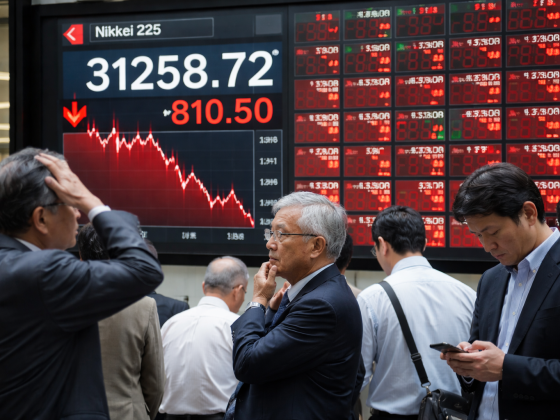
Asian markets tried to find their footing on Wednesday, but the calm looked fragile after a sharp unwind in the global AI trade reminded investors how quickly this year’s winners can turn into sources of stress.
The selling was not broad panic. It was more selective than that. Traders cut exposure to technology, semiconductors and other crowded growth trades, while money moved into government bonds and the dollar.
That mix gave the session a defensive tone even as some battered Asian markets bounced.
AI trade loses some shine
MSCI’s broad index of Asia-Pacific shares outside Japan was little changed, while South Korea’s KOSPI rebounded more than 2% after Tuesday’s 10% slide, its steepest one-day fall since March.
Japan’s Nikkei struggled for direction and was last lower, showing that investors were not ready to call an end to the volatility.
The trigger came from Wall Street, where the Nasdaq dropped 2.2% and the S&P 500 lost 1.4% as investors questioned whether the debt-heavy spending behind the AI boom can keep being rewarded at current valuations.
Semiconductor shares took the worst of the pressure, a reminder that the AI trade is no longer being treated as a one-way bet.
Analysts said the speed of recent swings, both up and down, points to a less stable market backdrop.
In other words, the issue is not just falling prices. It is the violence of the moves.
Oil relief tempers inflation fears
Energy offered some relief. Brent and WTI traded near four-month lows as more tankers began moving through the Strait of Hormuz after weeks of disruption linked to the Iran conflict.
Brent slipped to around $76.71 a barrel, while WTI traded near $72.85.
Lower crude prices ease one of the biggest inflation risks facing central banks. But traders are not treating the Middle East accord as settled.
The US and Iran still appear divided over key terms, including nuclear inspections and navigation through the strait.
That leaves oil vulnerable to another geopolitical shock.
Yen pressure keeps BOJ in focus
Currency markets added another layer of caution. The dollar index hovered near a 13-month high as investors priced in the risk of a more hawkish Federal Reserve.
The yen sat around 161.57 per dollar, close to levels that have previously put Tokyo on intervention watch.
The Bank of Japan’s latest signals also mattered. Policymakers raised rates to 1.0% this month, the highest level since the mid-1990s, and some board members have pushed for further moves toward neutral policy settings.
Gold slipped as higher rate expectations reduced demand for non-yielding assets.
For Asian markets, the message was clear: oil may be cooling, but AI valuations, the dollar and central bank policy are still capable of driving another bout of turbulence.
The post Nikkei 225 stumbles as Asian markets count the cost of AI trade reversal appeared first on Invezz